
Impact

Around here, shared dreams have a way of coming true.

We’re dedicated to giving voice and resources to programs that enhance the quality of life for people in Oceana County.

Complete Your Degree Program

In 2019, the Foundation’s Board began an in‑depth review of the impact of our scholarship programs, with a particular focus on how we could better support adult learners.

Out of this work emerged Complete Your Degree (CYD), a program pioneered by St. Clair Community Foundation to “redefine and reimagine how scholarship assets are used to support the continuing education of young adults.” CYD represents a new approach to supporting adult learners by reshaping the relationship between scholarship resources and real‑world barriers to education. Our goal is to help local adults earn degrees and credentials that increase household prosperity, strengthen our regional workforce, and address the employment skills gap in Oceana County.

The CYD program supports local adults pursuing degrees and credentials at Baker College, Muskegon Community College, or West Shore Community College. The program fills the remaining cost of tuition after all federal, state, institutional, and other scholarship resources have been applied. In addition, CYD provides life needs funding and access to a Success Coach to ensure students have the support they need to persist and complete their programs.

CYD students work closely with a Success Coach who offers individualized guidance, encouragement, and referrals to community resources. Recognizing that the true cost of education extends beyond tuition, life needs funding helps address basic needs and reduce barriers to completion. This support may include assistance with food, childcare, technology, housing, transportation, medical needs, or other critical challenges that can derail a student’s progress. The program prioritizes students who are at higher risk of not completing their degree due to life circumstances, such as single parenthood, first‑generation college status, financial hardship, or other systemic barriers.

For more information, check out our 2026 Complete Your Degree General Handout. If you are interested in supporting or learning more about this initiative, contact Elly Bainbridge, CYD Success Coach.

To learn more & apply – click here.

You can help support Oceana’s adult learners by making an online gift to the Complete Your Degree Program Fund here

Community Assessments

The Oceana Community Foundation was selected by the Council of Michigan Foundations (CMF) to participate in its Rural Economic Development Cohort initiative. This work aligns with the Foundation’s three‑year strategic plan and reflects our commitment to understanding and responding to community needs across Oceana County.

The goals of this initiative are to:

  • Build local leadership to support economic development
  • Strengthen connections between community foundations and local economic development partners
  • Conduct in‑depth community assessments
  • Receive expert guidance to turn community insights into meaningful action

The Foundation began this work by selecting the Shelby area for the first community assessment and recruiting a team of local leaders to explore economic development opportunities, conduct the assessment, and build relationships with state‑level economic development partners. On August 29, 2018, a diverse group of Shelby area residents and community leaders came together to share their thoughts, experiences, and hopes for the future of their community.

Building on this success, a second community assessment was completed in the Pentwater area in June 2019, led by the Pentwater Vision Team. Most recently, in collaboration with the Village of Hesperia, The Right Place, and the Oceana County Economic Alliance, the Foundation conducted a community assessment in Hesperia in fall 2021.

Following each assessment, consultants from the Community Economic Development Association of Michigan (CEDAM) compiled comprehensive reports by analyzing and summarizing community feedback. These reports offer valuable insights and help guide future action. Explore the reports below to learn more.

Shelby Area:

Shelby Area full report – Click here
Shelby Area summary report – Click here

MAJOR ASSESSMENT THEMES

  1. HOUSING: The Village has a high renter vs homeowner rate, and many of the rental properties are substandard. The affordable single family homes that are available, which are very few, are in need of repair.
  2. DOWNTOWN: The downtown is not “coherent”. The business mix is not conducive to attracting customers, quality of facades is spotty, and some buildings are in need of total renovation (especially in the rear of the building). The streetscape needs to be updated and beautified.
  3. QUALITY JOBS: The area is predominantly agricultural and there is not a diverse business mix. Many of the existing jobs are low paying.
  4. INCLUSIVE COMMUNITY: The Hispanic community is not represented in village government. Across the broader community, there appears to be some fear or lack of understanding of the value of sharing and learning cross-cultures.
Pentwater Area:

Pentwater Area full report – Click here
Greater Pentwater Area summary report – Click here

MAJOR ASSESSMENT THEMES:

  1. HOUSING: There is not enough year round housing that is affordable for young families, to support workforce growth or for seniors to age in place (no transitional housing).  The Village housing stock is more of a rental community than a family community.
  2. SHORT SEASONAL ECONOMY: Downtown businesses are more geared to visitors thereby leaving a void of needed goods and services desired by year-round residents. The short season also makes business attraction and investment difficult.
  3. COLLABORATION:  Bringing resources (service groups, organizations and public entities) together would yield better collective planning and results.
  4. INTERNET: Need affordable, reliable high-speed internet access, also providing new opportunities for people of all ages to work from home.
Hesperia Area:

Hesperia Area full report- Click here
Hesperia Area summary report-Click here

MAJOR ASSESSMENT THEMES

  1. DOWNTOWN: There are many vacant, dilapidated store fronts downtown. There is no organized effort or strategy to rehabilitate the buildings or attract new businesses to fill them. There is not plan for attracting customers/tourists to the businesses and other community assets in and/or near the downtown.
  2. COMMUNICATION: Communication is hampered in the community in several ways. First there is no affordable, dependable high-speed internet, and the cell service is spotty or nonexistent; and second, there is no reliable, “go to” source for information about what is going on in the community.
  3. ENHANCEMENTS TO NATURAL SPACES AND EXPANDING RECREATIONAL OPPORTUNITIES: There are no organized/convenient ways to market OR enjoy this beauty – no kayak or canoe launch; no trails system for hiking or cross-country skiing; no trails for biking or riding; no signage or marketing to attract tourists.
  4. ATTENTION TO THE NEEDS OF YOUTH: The problem of drug use and its impact on kids is perceived to be a problem. There was also a strong consensus that there is nothing for elementary age kids to do outside of school.
  5.  VARIED HOUSING TYPES AND PRICE POINTS: The community wants many things that could be made possible by developing different housing types at varied price points. Community members want to attract some type of business/manufacturing that would pay a decent wage and offer career opportunities for their kids so they don’t leave town after graduation or can be attracted back after they have left. They want to keep their seniors comfortable and safe. They want to attract new young families to populate their schools.
Walkerville Area:

Walkerville Area Full Report – Click here
Walkerville Area Summary Report – Click here

MAJOR ASSESSMENT THEMES

  1. BUSINESS AND RETAIL: The community members have dreams of (at the very least) a restaurant and access to fresh foods. There are vacant buildings with potential. There was interest from community business/building owners but they ran into roadblocks. Maybe a group of dedicated community leaders with a thoughtful, realistic plan can help bust through those roadblocks.
  2. COMMUNITY CENTER: An underlying theme was, “How do we rebuild community when we have nowhere to gather as a community?” Flowing from this theme were various suggestions like a community/recreation center. This type of facility might be a heavy lift, especially in the short term. However, with community partners such as churches, the school and other community stakeholders perhaps this goal of having a place for folks to gather might be achieved through other means, and could be incrementally visioned out once a location is secured.
  3. BASIC HUMAN SERVICES AND CHILDCARE: There are no human services providers with offices in Walkerville. One out of every three families live below the poverty level yet they are expected to travel to other communities to seek services. This issue might be addressed through outreach services, one day a week for example, possibly located in the community center envisioned by the community. The primary form of childcare is in private homes and is unregulated. All potential avenues to provide quality, affordable childcare need to be explored with human service partners, including the possible re-opening of the daycare center at Arbre Farms or a collaboration with an existing organization (such as a church). Businesses need employees and families need income – but this can’t happen without daycare.
  4. RE-BUILD COMMUNITY: Even the giggly, high school kids get serious when they talk about how they feel they don’t have a “community”. They don’t feel a sense of pride, nor do they feel it in the broader community. And they don’t think they, or the school, get enough support. The school is a tangible, obvious place to focus energy and resources to build the confidence, morale and spirit of the community. School and community leadership can work together to garner support and develop an action plan. Festivals and events are another way to re-build community, build pride, and bring people together. Longtime generational residents woefully remember a bustling village center, and family fun activities/events. They seem somewhat disheartened by memories of the past but hopefully, once marshalled, those feelings will motivate instead of demoralize.
  5. HOUSING AND INFRASTRUCTURE: The community wants many things that could be made possible by improving housing. They want to clean up and beautify Walkerville. They want to attract new young families to populate their school, and to add an infusion of fresh enthusiasm and energy to community events and activities. They want to attract good teachers and other employees with decent, affordable rental and homeowner housing options. One problem that hinders progress in housing is the need for upgraded infrastructure. Infrastructure and housing improvement/development are certainly stretch goals, however the community wants and needs them badly. These issues must be priority and on the radar of community leaders; even incremental steps could make a big difference.
  6.  

Leadership Learning Lab

In today’s complex world, especially with the service pivots necessitated by the pandemic, the conditions to be successful are constantly shifting, requiring people from all sectors to lead with a new kind of courage and skill. The Leadership Learning Lab helps leaders to become a more adaptive leader and to take the time to learn, practice, and experiment with new skills acquired in the Lab. The Lab hosts monthly workshops at five regional sites, with Oceana, Mason and Manistee leaders together at the Lakeshore Resource Center in Ludington. The Lab aligns with the Oceana Foundations’ strategic efforts to support capacity building among local nonprofits.
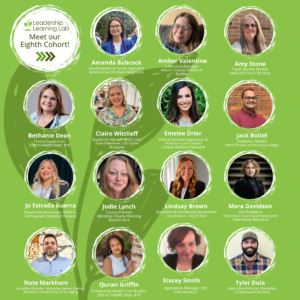
2025-26 Learning Lab Cohort
Learn More

The Lab was born out of the collaboration of 10 northern Michigan community foundations that recognized they could do more together than separately, and funders that wanted to invest in a new way of empowering communities. Facilitated by Rotary Charities, and funded by the Frey Foundation and the local community foundations, the Lab seeks to connect and empower nonprofit executive directors and emerging leaders and give them the skills to strengthen the organizations and communities they serve. The Lab is supported by the Foundation’s Administrative Fund as a leadership initiative.

This program has supported 26 leaders in a wide range of positions across Oceana County. Providing a trusted space for rising nonprofit leaders to develop their talents and a plan for the impact they wish to make within their local communities is invaluable. The Lab is an investment into planting the seeds of open communication and support between different organizations, not only between the nonprofit leaders but also amongst the participating foundations.

The application to join the 2023-24 cohort is now closed. However, we invite you to consider a future cohort and we will announce when the application opens again. Leadership Learning Lab combines monthly sessions, small groups, social media, and cohort support as a year-long program. While learning more about leadership, participants will also network and develop connections with other community leaders. We welcome leaders at all levels from nonprofit organizations, businesses, government agencies, and Tribal Nations. To learn more, visit LLL Program’s website.
Seventh Cohort - 2025

Amanda Nasor 
Interim Executive Director, Communities Overcoming Violent Encounters 

Bethany Wise 
Girls Camp Director, American Youth Foundation – Camp Miniwanca 

Caleb Ackerman 
Museum Engagement Manager, Mason County Historical Society 

Erin Oleniczak 
Public Health Planner, District Health Department #10 

Gwen Adams 
Executive Director, Sandcastles Children’s Museum 

Jenni Payne 
4-H Youth Program Coordinator, MSU Extension-Oceana 

John Jackoviak 
Senior Procurement Manager, Peterson Farms, Inc. 

Julie Herringa 
Executive Director, Manistee County Library 

Katie Gruenberg 
Planning Director, Manistee County 

Kim Corliss 
Chief Operating Officer, Northwest Michigan Health Services, Inc. 

Laura Ackerman 
District Manager, Oceana Conservation District 

Tara Autrey 
Community Outreach Specialist, Community Foundation for Mason County 

Tricia Polcik 
Clinical Director – Adult Services, Centra Wellness Network 

Sixth Cohort - 2024

Sky Harsch, Stewardship Coordinator for the Oceana Conservation District

Hannah Naples, Program Officer at the Oceana Community Foundation

 John Medendorp, Pastor of New Era Christian Reformed Church

Amber Rumsey, Regional Childcare Coordinator for United Way of the Lakeshore

Phil Santellan, Public Health Educator at District Health Department #10

Susan Tippet, Ferry Township Planning Commission and Zoning Board Administrator

Fifth Cohort - 2023

Rubi Berumen, Departmental Supervisor for the Michigan Department of Labor and Economic Opportunity (LEO)

Aubrey Boerema, Executive Director of Stony Lake Therapeutic Riding Center

Curtis Burdette, Executive Director for Oceana County Economic Alliance

Mark Olmstead, Superintendent of Shelby Public Schools

Griffin Vogler, Director of Camp Miniwanca

Fourth Cohort - 2022

Scott Beal, Director of the Hart-Silver Lake Chamber of Commerce/Visitors Bureau

Tracey Blamer, Director of Procurement at Peterson Farms

Steve Bruch, Economic and Community Projects Coordinator for Oceana County

Terri Demeter, Advancement Coordinator and Finance Manager at the Fountain Hill Center

Irma Hinojosa, Chairperson of Oceana Hispanic Center and West Michigan Migrant Resource Council Boards

Mark Kraus, Community Liaison Development Director at TrueNorth Services

Sarah Oleniczak, Deputy Health Director at the District Health Department #10

Kathleen Rash, Library Diector at the Hart Area Public Library

Elizabeth Russell, Board Secretary and Grant Writer at the Pentwater Historical Society

Third Cohort - 2020

Paul Erickson, President of Oceana County Fair & Oceana County Historical Society

Kortni Garcia, Public Health Educator, DHD #10

Jodi Nichols, Business Development Coordinator, Oceana County Economic Alliance

Sarah Schaner, 4-H Program Coordinator, MSU Extension

Danielle Siegel, Program Assistant, CFOC

Second Cohort - 2019

Tiffany Collins-Haight, Director, Shelby Area District Library

Emma Kirwin, VP Walkerville Thrives, Leavitt Township Supervisor

Rob Widigan, Administrator, Village of Shelby Village

Julie Kreilick, Director, Hart Main Street

Maggie Bowman, Clearinghouse Coordinator, Love INC Oceana County

Catalina Burillo, Community Health Improvement Coordinator, Health Project

First Cohort - 2018

Kittie Tuinstra, Executive Director, Oceana’s Home Partnership

Suzie Geerlings Knoll, Executive Director, Oceana Conservation District

Alyssa Merten, Program Director, Oceana College Access Network

Eva Berumen Reyna, Executive Director, Oceana Hispanic Center

Stephanie Moore, Associate Director, Oceana County Council on Aging

Brian Beckman, Director, The Ladder Community Center

Oceana CAN!

In 2013, the Foundation coordinated local stakeholders, including educators, employers, non-profit agencies, and other community partners, to address the educational issues that are an intrinsic part of living in a poor, rural county. Graduation rates are low. Young adults were not pursuing post-secondary credentials, including degree’s, certifications, or skilled trades training, at the same rate as other Michigan communities. Employers often cannot find qualified applicants for open positions requiring training and unemployment rates are high.

Out of their discussions, the Oceana College Access Network (OCAN) was formed to help alleviate poverty, improve our local workforce, and build a vibrant economy.

Learn More

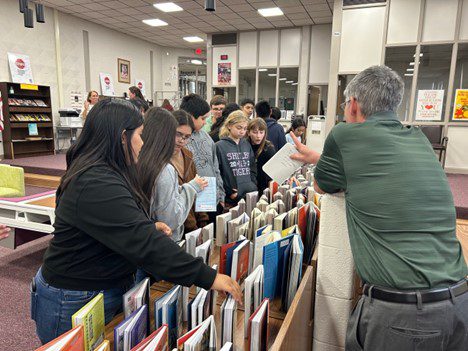
OCAN is working to ensure all students, including adult learners, are prepared for and have access to post-secondary education and training.  OCAN is building a culture of learning, lowering systemic barriers, and increasing family engagement. The Network has coordinated a set of college access initiatives aimed at supporting students with the exploring options and the college application process through to completion of a degree or credential. Programming is geared particularly towards those who come from low-income families and/or those who are first in their families to pursue a college degree or valuable credential.

The Foundation acts as the fiscal partner and provides important leadership capabilities. OCAN is also supported by the state-wide Michigan College Access Network with grants, technical assistance, and resources. Additional network support comes from other grant funds, sponsorships, and continued network partner support.

The OCAN Coordinator leads the work of the action teams. These teams are comprised of on-the-ground service providers who bring programs such as Students in the Workplace, the College & Career Fair, College Application Day, FAFSA workshops, and campus visits to Oceana students.

Currently, only 27% of working-aged adults in Oceana County hold an associate’s degree or higher (compared to 47% in the state). Considering over 72% of jobs nation-wide will require a degree or credential by 2031, it is imperative to equip all students with the resources and mindset to pursue and complete higher education after high school. Current statistics reveal that while 97% of Oceana’s high school graduates fill out at least one college application, only 66% enroll and only 33% actually complete a program or acquire a degree. This is a long-term effort and we continue to observe progress on all tracked metrics. To learn more about this initiative, visit www.oceanacan.org.

You can help build a culture of college & career readiness and success in Oceana by making an online gift here.

Oceana Lakeshore Employer Resource Network

The Oceana Lakeshore Employer Resource Network (ERN) is a network of local employers who come together to respond to issues like turnover, productivity, training, and employer retention. Created in 2016, the ERN continues to work with Oceana County’s workforce to mutually support each other’s success. The Foundation provided leadership in convening partners to form the ERN, assisted with developing a 2-year co-funding strategy to help initial member costs, and provided seed grant funding. The ERN strives to improve communities by supporting local employers in retaining an engaged, skilled workforce. They additionally support nonprofits and their programs’ outcomes to advance community economic independence.

Learn More

Network members include:  

  • Arbre Farms,  
  • Country Dairy,  
  • Oceana County Medical Care,  
  • Michigan Freezepack 
  • Peterson Farms,  
  • Shelby State Bank, and  

Strategic partners include: 

  • ERN-Michigan,  
  • Community Foundation for Oceana County, 
  • Michigan Career Technical Institute
  • Michigan Department of Health & Human Services
  • MI Works! West Central
  • Oceana Hispanic Center, 
  • United Way of the Lakeshore-Oceana  
  • Great Lakes Energy People’s Fund & Pennies From Heaven Foundation were provides start-up funding.

The heart of the ERN model is onsite, confidential Success Coaching that employees can access on a predictable, ongoing basis. No more wasted hours in social services offices; Success Coaches offer direct connection and access to community resources. Employees who face a crisis from lack of resources can get immediate, personal relief, onsite. Services are available to all employees in the member companies. Success Coaches accommodate all shifts with off-site locations and alternate meeting times available upon request. Oceana’s success coach is bilingual and is contracted via the Oceana Hispanic Center.

Another ERN service is the Bridge Loan program, which allows the coach to connect clients to fair and reputable lending. These loans help clients overcome financial burdens that may be negatively impacting their life including auto repairs, credit repair, payday lending traps, appliance purchases, debt, and family emergencies. The loan program also includes a savings component of $10 per week into a savings account, not accessible until the loan is paid in full. Upon pay-off, the client is encouraged to continue the habit of savings. Shelby State Bank services the Bridge Loan program at  supportive  interest rates.

Oceana’s ERN successfully initiated a pilot manufacturing training program in 2016, in collaboration with Michigan Career & Technical Institute (MCTI). This program helped to fill the skill gaps of several job-seekers to achieve full-time competitive employment in the food processing sector. Based on that success, the Foundation assisted MCTI in forming a task force of food processing manufacturers to identify relevant training programs, including curriculum offered by the Canadian Food Processors Institute, to be used for the Registered Apprenticeship Program and a future School-to-Registered Apprenticeship. These programs will help to fill the skilled labor need in Oceana County and provide career-laddering opportunities for students and current workers. Through this process, the first ever food processing registered apprenticeship program with the Department of Labor was established. A big win for Oceana and for the nation. In August of 2019, five incumbent workers at Peterson Farms started in the one-year certification program.

You can help the Foundation lead initiatives like the ERN by supporting our Administrative Fund here.

Read early. Read often.

In 2016, the Oceana Community Foundation joined hands with local partners to launch Read Early. Read Often. (RERO) with a shared dream: to give every child in our community the strongest possible start in school and in life.

Now in its 10th year, RERO continues to nurture that vision by strengthening early literacy, improving third-grade reading proficiency, and opening doors to brighter futures for children across Oceana County.

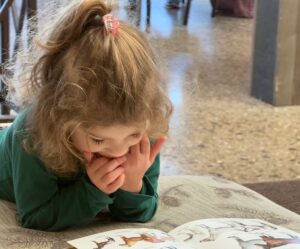
We know that a child’s journey begins long before the classroom. Early literacy helps shape confidence, curiosity, and lifelong success. And those first steps are simple but powerful—placing books into little hands, sparking imagination, and helping children discover the joy of reading.

Everyday moments matter. When families talk, read, and sing together—at home, in the car, or while running errands—they turn ordinary moments into meaningful opportunities for learning and connection.

This work is truly a community effort. Libraries, early childhood centers, childcare providers, medical offices, food pantries, churches, health clinics, and local nonprofits are all coming together with one goal: to share the joy of reading and ensure that every child in Oceana County has access to books and the chance to thrive.

Together, we are not just building readers—we are building futures.

Find Free Books Across Oceana County

We believe every child should have books at home. That’s why free books are available across Oceana County in ways that make it easy—and fun—for families to take part:

RERO hands out books at community events throughout the year, including Easter, Halloween, Thanksgiving, and Christmas celebrations.

Literacy Corners, located at:

  • Dr. Phares Dental Office (New Era)
  • Rothbury Village Hall
  • Shelby State Bank (Hart, Hesperia, Pentwater, Shelby)
  • Area Play & Learns (Hart, Shelby, Walkerville)


Oceana County Free Little Libraries (see locations below)

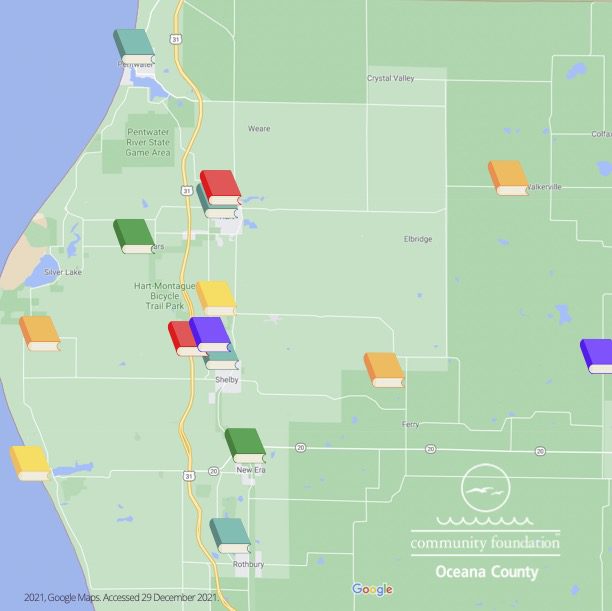
Find a Free Little Library Near You

In 2018, thanks to Eagle Scout Thomas Carey of Shelby Troop #1151 and support from the Rural Council of Michigan, three Little Free Libraries were built in Benona, Golden, and Ferry Townships—bringing books to communities without nearby schools or libraries.

With additional support from United Way and the generosity of community members and local businesses, the network has grown to 14 Little Free Libraries across Oceana County.

Today, RERO keeps these libraries stocked with books year-round, helping ensure every child has access to stories and opportunities to learn.

Explore our map to find a Little Free Library near you—and discover the joy of sharing a book.

Tools to Help Your Child Learn to Read (RERO + Great Start Collaborative)

RERO proudly partners with the Mason-Lake-Oceana Great Start Collaborative (GSC) to bring meaningful literacy resources and support to families across Oceana County. Together, we work to ensure every child has the opportunity to build strong early reading skills and a lifelong love of learning.

InspiReading: Literacy

Children are never too young to discover the joy of reading. Through inspiReading, families, schools, and community partners are empowered to nurture that love from the very beginning.

This initiative offers simple, practical tools to strengthen key literacy skills—including motivation, phonological awareness, phonics, fluency, vocabulary, and comprehension. InspiReading strategy cards and videos provide easy ways for parents, caregivers, and educators to support children’s reading growth every day.

Explore resources: https://www.greatstartmlo.org/inspireading-about-us

Talking Is Teaching

Talking Is Teaching: Talk, Read, Sing is a national campaign that reminds us how powerful everyday moments can be in a child’s development. From birth, simple interactions—talking, reading, and singing—help build strong brains and language skills.

With easy-to-use tips and tools, this initiative helps families turn daily routines into opportunities for connection, learning, and growth.

Learn more: https://talkingisteaching.org/resource

Our Supporters & Community Partners

We are deeply grateful to the organizations, businesses, and individuals who make this work possible:

Foundations & Grant Support

  • Gerber Foundation
  • Children’s Trust Fund
  • Great Lakes Energy People Fund Grant
  • CEDAM (Community Economic Development Association of Michigan) – Rural Partners of Michigan Grant
  • Oceana Community Foundation Funds:
    • Youth Advisory Council
    • Thomas Pische Memorial Fund
    • Little Point Sable Arts for Oceana County Fund
    • Mary Ann Peterson “Grandma Pete” Fund
    • Ralph’s Kids Fund
    • Nancy Zielinski Fund
    • Ordoobadi Family Fund

Community Organizations

  • Women Who Care of Oceana County
  • Shelby Optimist Club
  • Shelby Early Childhood Center (ECC) Staff
  • Shelby Public Schools Parent Teacher Organization

Individual Donors

  • Max & Evelyn Kokx
  • Jean Miller
  • Doug & Mary Ruby
  • Geoffrey & Gail Turk
  • Joan Lound
  • Mark & Mary Jane Benner
  • Barbara Rohwer
  • Lois & William Lydens
Our Community Literacy Partners

Across Oceana County, our partners are helping families access books, programs, and support that build a lifelong love of reading:

Literacy Programs

Local Libraries

Youth Advisory Council (YAC)

In 1989, W.K. Kellogg Foundation conceived an idea to help seed community foundations throughout Michigan if the local Foundation agreed to establish a permanent youth fund and a Youth Advisory Council (YAC). They wanted to help create a strong philanthropic training ground for youth and, in a few short years, over 86 YACs were formed across Michigan. The goal was to help young people learn generosity and leadership and at the same time build stronger and more caring communities.

Give to Oceana’s Youth Fund and support our YAC here.

photo of YAC
What is the Youth Advisory Council (YAC)?

The Youth Advisory Council is a special “youth as grant makers” project of the Community Foundation for Oceana County. The Council, made up of adult advisors and 45 student representatives from Oceana County’s area schools, involves young people in solving real problems affecting their communities and peers. YAC members help set policy and guide distribution of over $20,000 a year in grants to promising youth related projects in Oceana County. This special group of young people are Oceana County’s own local panel of experts regarding youth issues who provide recommendations to the Community Foundation for Oceana County’s board of directors about grants to be awarded from the fund each year.

2019 Youth Needs Assessment

Following Council of Michigan Foundation’s best practices, the Council is tasked with conducting a County-wide needs assessment survey every three years.

A YAC sub-committee designed and administered the survey, with the support of school administration.  Over 650 youth responded to the survey, from 6th-12th grades, evenly spread across school districts and gender.  Respondents identified top issues from a list of 42 options affecting themselves and their peers. The top 5 issues stood well apart from the rest (ranked 1-5): stress from schoolwork, vaping use, bullying in school, depression/suicidal thoughts, and lack of self-esteem.

Collectively, YAC members have determined priority areas for their activities and grantmaking.  The youth agreed that many of the issues that came to light through this survey were mental health related.  Others that were behavioral, such as vaping use, the group determined could be coping mechanisms teens turn to when dealing with stress and depression.  YAC members decided to prioritize mental health and positive coping mechanisms for stress for their 2020 work.

Read the full story in our news section or check out the full set of results here.

What do Members do?

Members of YAC attend one meeting a month to make grant making decisions or to learn more about youth issues in Oceana County. Four times a year the Council reviews grant proposals for youth projects and determines which projects will receive funding by evaluating the proposals and making site visits to the agency requesting funding. Since its inception, our YAC has made over 449 grants to local youth projects totaling over $432,000.

For more information on our Youth Advisory Council, call 231.869.3377.